 AGC Systems’ Aldo Cugnini has been featured in the ATSC website and Newsletter as “Someone You Should Know.”
Click here to see the full story.
= 30 =
Committed to principled innovation and nonpartisan communications technology solutions
AGC Systems’ Aldo Cugnini has been featured in the ATSC website and Newsletter as “Someone You Should Know.”
Click here to see the full story.
= 30 =
There will be a rare astronomical event this Monday, November 11, 2019, when Mercury passes in front of the sun. We’ll be streaming it live from NJ using a telescope. The event occurs only about 13 times a century.
Click on the player to see the live stream during the event! We’ll also stream the end, at 1:00pm EST, and on the quarter-hour in between, as well. Weather permitting!

Many consumers have long admired the Android operating system as a more “open” alternative to the closed iOS ecosystem. But more and more, Google seems intent on ruining this past advantage. Already, highly-admired features, like running apps from an SD card (and getting add-on storage), have been dropped from most phones. And while Google has claimed that change was for “better security,” many observers felt it was simply to upsell more storage.
Now, with its latest rev — Android 10 — Google adds more than 60 new features to the OS. And while some of these again are “security updates,” you can find gobs of information elsewhere that runs them down. BTW, rumor has it they didn’t give this “Q” release a food-name, because of lack of a good candidate. Really? What’s wrong with “quince,” or “quinoa”?
The rev does come with a host of new issues, however, such as the following:
Of course, any software update will have its growing pains, along with some workarounds. But when you build a feature like Location Cards and don’t think through something that would be obvious to any user, you’ve got a serious problem somewhere in the product development process. And what’s really inexcusable is that, from the posts on Google Help, it seems that issues like the Location Card problem have been known to Google even with Android Pie — and their staff responds by saying the behavior is “subjective.”
You’d think Google would have the resources to develop features that are useful and not annoying. Perhaps 10.1?
— agc
More than 100 NAB Show sessions and more than 50 exhibitors will feature Next Gen TV technology that is now voluntarily spreading to cities throughout the country. Powered by the ATSC 3.0 next-generation broadcast standard, Next Gen TV promises to deliver sharper, more detailed pictures and lifelike multichannel audio with upgraded broadcasts that will be transmitted and received in the same Internet Protocol language as Internet-delivered content.
Jointly sponsored by the Advanced Television Systems Committee, the Consumer Technology Association and NAB, the “Ride the Road to ATSC 3.0” exhibit will be featuring a series of free presentations about all facets of the ATSC 3.0 standard. And attendees can pick up a free Guide to 3.0 at the Show in the Central Lobby of the Las Vegas Convention Center during the show.
The NAB, with support from a number of technology companies, will demonstrate the Single Frequency Network (SFN) capabilities of the Next-Gen TV standard, showing how reception can be improved in difficult locations and in moving vehicles by deploying multiple broadcast towers transmitting the broadcast signal on the same channel.
Using several local transmissions, special SFN viewing kiosks will showcase the flexibility of the ATSC 3.0 standard. Dozens of sessions planned in the exhibit will include updates on the Dallas, Phoenix, Santa Barbara, East Lansing, Cleveland, and Korea ATSC 3.0 deployments.
Scores of papers and sessions will be presented about Next-Gen TV during the 2019 NAB Show, with session topics that will cover consumer research, consumer device plans, conformance testing, audio enhancements, station build-out advice, watermarking, advanced emergency information, channel security, advanced advertising
AGC Systems president Aldo Cugnini will be at the show, and available for discussions regarding support for ATSC and other related ventures. If you’d like to meet up, please contact us.
This month, the Federal Communications Commission allowed a plan to make the spectrum above 95 GHz more readily accessible for new innovative services and technologies. Calling the initiative “Spectrum Horizons Experimental Radio Licenses,” the plan is outlined in a First Report and Order, which allows a number of changes to existing rules, including:
The Order specifically allows two types of operations:
Part 15 of the FCC Rules was also amended to extend operational limitations and interference measurements covering frequencies above 95 GHz.
The new rules provide that the Commission may, at any time without notice or hearing, modify or cancel a Spectrum Horizons License, if, in its discretion, the need for such action arises. Some commenters raised the issue that this could result in an abuse of the complaint process, but the Commission pushed back, saying they “routinely work with parties to resolve potential or actual issues…”
The Commission withheld action on their proposal for licensed fixed point-to-point operations in a total of 102.2 gigahertz of spectrum, and opposed the concerns of the ham-radio organization ARRL regarding protection from interference. In defending the latter position, the Commission states, “both the amateur radio service and the experimental licensing program are designed to contribute to the advancement of radio knowledge,” and goes on to say that “we will instead require all Spectrum Horizons License applicants to submit an interference analysis that would address the potential effects of the experimental operation on existing services.”
In addition to Chairman Ajit Pai, the proposal has general support — albeit with certain cautions — from all four of the other commissioners, who evenly represent both sides of the political aisle.
— agc
 In an episode of the TV series The Sopranos, Carmela Soprano discovers that she is unable to retain a competent lawyer for her divorce proceedings, apparently due to her husband Tony having contacted a number of them in advance, ostensibly for advice on unrelated matters. In so doing, Tony deviously “polluted the attorneys” by creating a conflict of interest for them.
It would seem that some law firms may be incorporating this questionable practice into their strategy of obtaining subject matter experts and expert witnesses for high-profile litigation. Apparently, their strategy involves interviewing a large number of known experts, through a broker, requiring the candidates to agree to non-disclosure during the initial email contacts, and then rejecting them as candidates, often cutting off all further communications.
By doing this, the experts are then precluded from being retained by the opposing party, due to a “restrictive covenant” in the original email communication, with no confidential information having been exchanged, and with no compensation for their acquiescence. Essentially, the expert has provided value to the broker and law firm (exclusivity), in return for nothing.
I can describe my own experience in these matters. I was approached to consult as a subject matter expert for a number of very-high profile cases, and each time, I was directed to agree to a “confidentiality agreement” before I was interviewed for suitability. Objectively, it appeared that I was one of very few people who was an extremely good match to a very specific — and narrow — set of experience requirements. Nonetheless, I was rejected, after responding to an email containing a restrictive covenant, with no further communication at all.
Lest the reader conclude that I simply was rejected as non-qualified, I can point to the fact that, in several instances, all communication ceased after I solicited a sample NDA, without having mentioned compensation or any other conditions. It would seem there is something unreasonable going on here.
The solution to expert-pool contamination requires a willingness by all parties to accept responsibility.
–agc
Math can be truly awe-inspiring, as in this example of the unexpected places that π can show up. The proof is nothing short of elegant – be sure to watch parts 2 and 3. Astonishing!
–agc

With the ATSC 3.0 standard essentially finished last year, the casual observer might have expected to see new product at this year’s CES Show in Las Vegas.
Indeed, while there were a few 3.0 TVs scattered about – including at invitation-only showings by well-known TV manufacturers at suites and hotels – they were only early prototypes, since we shouldn’t expect to see real product announcements until the 2020 show – which just happens to be when broadcasters have said they will crank up transmissions using the new standard.
Echoing this at the show was the VP of Communications at LG, John Taylor, who said, “We expect that the launch pad is really 2020,” which is consistent with the typical 18 to 24 month silicon design cycle for chips to follow a new standard.
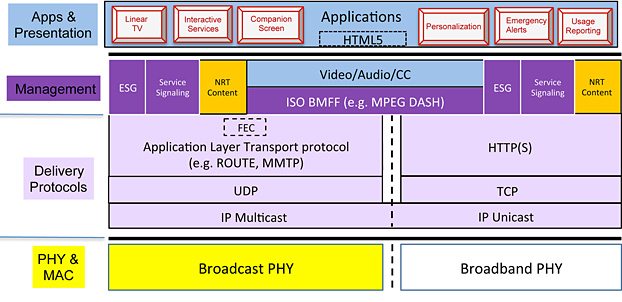
ATSC 3.0 is, of course, the latest version of the Advanced Television Systems Committee (ATSC) standard. It will support several advances including mobile viewing, 3D television, 4K Ultra High Definition (UHD), high dynamic range (HDR), high frame rate (HFR), and wide color gamut (WCG) picture quality, as well as immersive audio and interactivity.
Until we see those new products emerge, the news we’re more likely to see will be from broadcasters.
ONE Media LLC, a subsidiary of Sinclair Broadcast Group, and India’s Saankhya Labs, together with VeriSilicon and Samsung Foundry, announced at CES the successful launch of an advanced multi-standard demodulator System-on-a-Chip (SoC) supporting the ATSC 3.0 standard.

The universal demodulator chip is based on Saankhya’s patented Software Defined Radio Platform, and supports 12 DTV standards including ATSC 3.0, DVB-T2, ISDB-T, and satellite and cable standards for TV, set-top boxes, and home gateways, as well for automotive and mobile applications.
This announcement follows Sinclair Broadcast Group’s recent commitment to a nationwide roll-out of ATSC 3.0 service and its past announcement to fund millions of chipset giveaways for wireless operators.
Two variants of the chip were announced: a “Demod-only” variant, SL3000, is designed for TV applications such as in HDTV sets, Set-top Boxes (STB) and home gateways. A “Demod-plus” Tuner variant, SL4000, is designed for mobile and portable devices, possibly making it the world’s first mobile-ready ATSC 3.0 chip. The mobile device is targeted to accelerate the adoption of the ATSC 3.0 standard across markets with both Direct-To-Mobile TV capabilities and Broadcast/Broadband convergence solutions.
The demodulator SoC was designed and developed by Saankhya Labs with ASIC turnkey design and manufacturing services from VeriSilicon, using Samsung Foundry’s state-of-the-art 28FDS (Fully Depleted SOI) process technology), chosen for its low-power capabilities.
Mark Aitken, President of ONE Media 3.0, said,
These mobile 3.0 chips validate the ‘sea change’ in over-the-air distribution of not only television, but all digital data. Broadcasters are doing their part by deploying the NextGen transmission facilities, and now there will be devices enabled to receive that data, personalized and in mobile form. This chip is the key to that disruptive future in a 5G world.”
SK Telecom and Sinclair Broadcast Group announced in Las Vegas that the companies signed a joint venture agreement to lead next-generation broadcasting solutions market in the U.S. and globally. The two companies will jointly fund and manage a joint venture company within the first quarter of this year. The joint venture company will develop innovative broadcasting solutions based on ATSC 3.0.
The commercialization of broadcasting solutions based on ATSC 3.0 – which enables data communications in broadcasting bands – will give rise to new services such as personalized advertisement and in-vehicle terrestrial TV broadcasting and map updates. It will also support two-way communication between broadcasting companies and user’s smartphone/vehicle/TV by recognizing user’s personal IP address.
SK Telecom and Sinclair anticipate all television broadcasting stations throughout the U.S. will adopt broadcasting solutions based on ATSC 3.0 within the next decade. Through the joint venture company, the two companies plan to actively provide ATSC 3.0 standards-based solutions to all U.S. broadcasting companies and seek other opportunities globally. The joint venture agreement follows last year’s memorandum of understanding (MOU) signed between SK Telecom and Sinclair at CES 2018 to jointly develop leading technology for ATSC 3.0 broadcasting.
 Separately, the two companies also announced at the 2019 CES Show that they signed a Memorandum of Understanding (MoU) with Harman International, a subsidiary of Samsung, to jointly develop and commercialize digital broadcasting network-based automotive electronics technology for global markets.
The companies intend to unveil their automotive platform and related equipment and services for the first time at the 2019 National Association of Broadcasters Show (NAB Show) in Las Vegas in April 2019.
— agc
The landmark film is being re-released in select U.S. theaters this month, to mark the 50th anniversary of Stanley Kubrick’s science fiction blockbuster.
You should go see it, either again, or for the first time.
First of all, it’s an artistic masterpiece that stands up well, even after five decades of cinema technology advancement. And the story, at the very least, is thought-provoking. Never mind that the allegory is at times radical, to say the least.
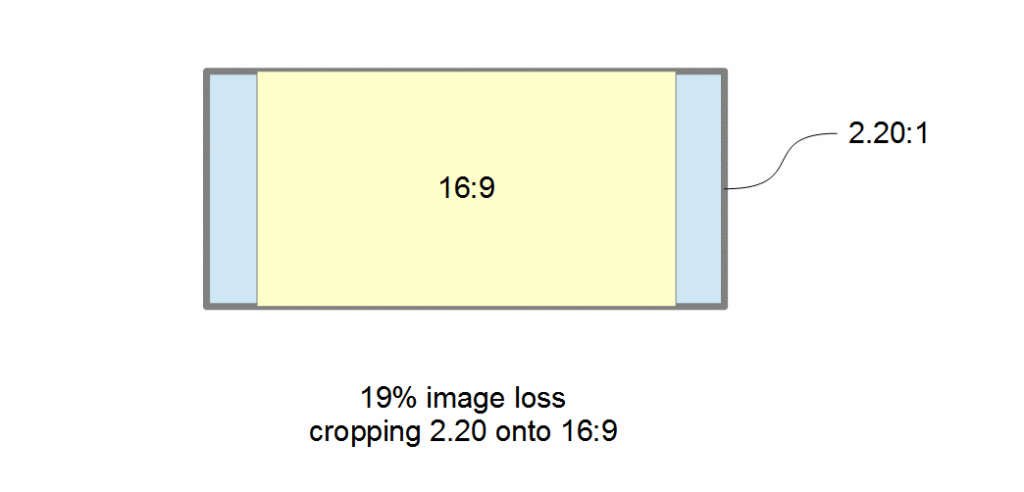
But there’s a technical reason to go see it in a theater: if you’ve only seen it on a video display in your home, you’re missing out on the way Kubrick captured the images. This is because the film was shot in Super Panavision 70, which uses a 65 mm negative, and spherical lenses, to create an aspect ratio of 2.20:1.
Since your “puny” HDTV at home has an aspect ratio of 16:9 (1.78:1), this means that every electronic reproduction of the film has either been heavily cropped (at the sides), or has been letterboxed. The former means you’ve lost parts of the image, and the latter means you’ve lost resolution.
Plus, seeing it on a large screen in a theater completely outperforms seeing it on a little screen in your home. And the distribution is in a clean, unretouched 70mm print.
Go see it! In New York City, it’s playing at the Village East, May 18 – May 24. Check your favorite website for other cities.
— agc
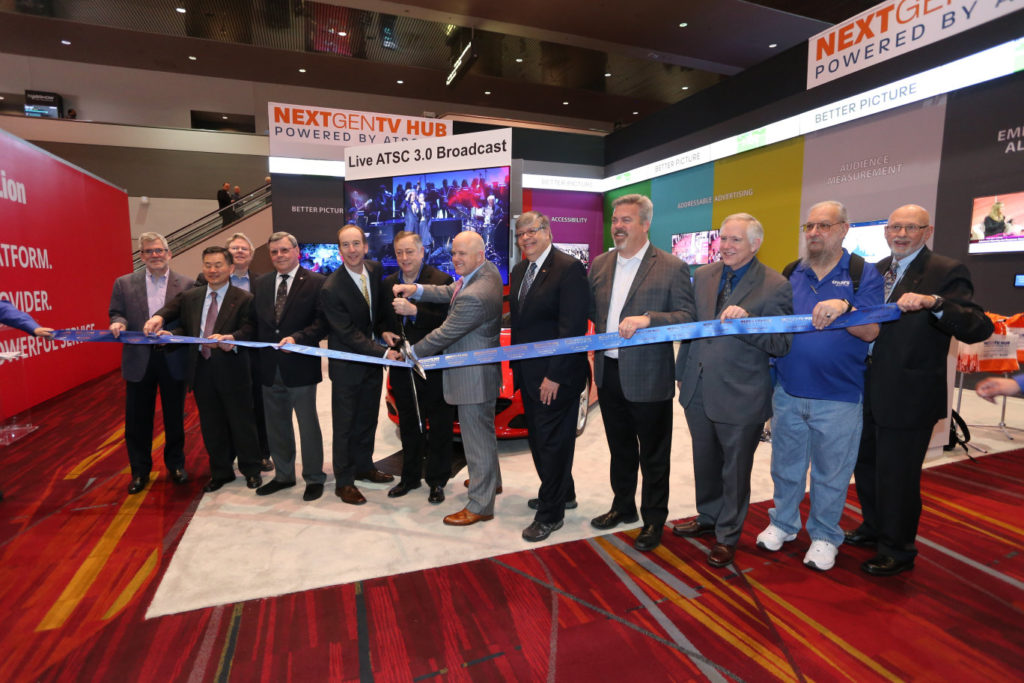
“The Road to ATSC 3.0: Powered by ATSC 3.0” Ribbon Cutting CeremonyDeployment of ATSC 3.0 is off and running, with a strong showing this month at this year’s NAB Conference in Las Vegas. More than 40 exhibitors and 22 technology-and-business sessions demonstrated the level of interest in the new Next Generation Broadcast TV standard, with a ribbon-cutting ceremony kicking off the activities.
ATSC President Mark Richer underscored the level of 3.0 presence at the show, saying “That’s how we know it’s real, and that’s how we know it’s happening,” and Sam Metheny, EVP/CTO at NAB, said that while ATSC is now “moving to the implementation phase,” it is a “living standard that will continue to evolve over time.” Mike Bergman, Senior Director, Technology & Standards at the Consumer Technology Association, anticipates “broad deployment, and a breathtakingly immersive viewing experience,” which should complement the growing momentum of 4K TV sales.
Now that the ATSC 3.0 standard has been approved, broadcasters can develop two-way, IP-based connections with their viewers and deliver TV experiences on par with other digital media. Looking to the future, conference panelists addressed key Next Gen TV capabilities, including enhanced audience insights, addressable advertising, interactivity, and personalization, along with plans to generate incremental revenue and audience engagement.
Broadcasters are used to slow change, but now need to change faster, even on a monthly basis. The world is changing faster, and consumer demands are changing, with OTA viewership growing, and OTT services and usage growing. Mobile viewing continues to increase, a cord cutting / shaving / nevers are changing TV marketplace dynamics. On-demand viewing is an assumed feature, and digital advertising is increasingly powerful, so targeted advertising is now essential.
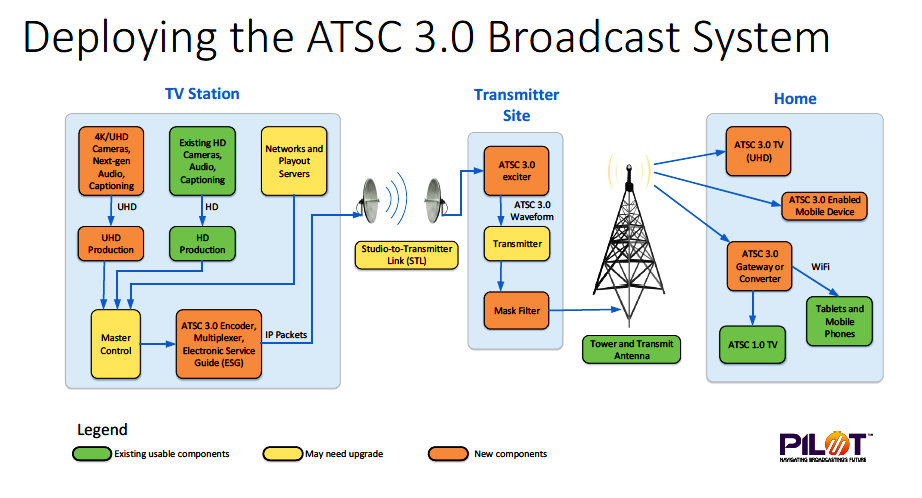
SFNs (single-frequency networks, a broadcast technology comparable to mobile cellular networks) will enable all of these new services, and data analytics will drive the opportunities. The WiFi/mobile broadband return channel defined by ATSC 3.0 means that even simple receivers need a back channel.
While MVPDs (Multichannel video programming distributors, i.e. cable and satellite) have long provided a revenue stream to broadcasters through retransmission-consent agreements, this could be one key area of the change in business model made possible by ATSC 3.0, which is not mandated by the FCC, other than at the transmission layer, and whose carriage is not currently subject to retrans obligations.
Broadcasters are interested in gathering viewership data from mobile devices and doing dynamic ad insertion. Reaching individuals will be attractive to advertisers, and broadcasters can now put movies into home boxes for Netflix, bypassing MVPDs. ATSC 3.0 is thus poised as a medium to test new business models, and broadcasters can partner with other spectrum owners and mobile carriers to supplement the “traditional” mobile spectrum.

The Phoenix Model Market project is the first collaborative single-market effort to plan for and implement a transition to next-generation over-the-air television broadcasting. Twelve stations in the Phoenix market are participating, with service testing expected to start Q2’18, and consumer service testing in Q4’18. In addition to business model testing, consumer testing will extend into 2019.
Among the consumer-facing business models to be tested are program guide & hybrid TV, personalization, and emergency alerts. On the broadcaster side, content protection, data & measurement, advanced advertising, and transition models will be evaluated.
— agc